"a manifestation of emotional pain" @_cocom.70k_

Dear Diary,
My name is Jenny Arredondo, I am a Peruvian painter and I'm currently in my 4th year at the Fine Arts program. I mainly work with oil or acrylics but my goal for this year is to try new media / materials
I love the ideation part, where I give myself permission to try something new; whether it's a medium or a topic, and to "bring something to the table". Actually, I used to hate this part because it was obligatory in some courses and, in my opinion, obligation limits creativity. But now I understand its importance. Alternative — or supplementary — materials or techniques give freshness to my artworks. All that can make my pieces more memorable and showcase more versatility. Moreover, topics that are not talked about enough — or perhaps the unknown ones — are often the ones that make the biggest impact. I love doing my research and bringing them to light.
My favourite piece of artwork I made would be "Bedsores / Pressure Ulcers" because it was the first time I felt I could call it "my art". It shows a horse lying on its back, in pain, surrounded by dirt, flesh-like blobs and some elements resembling the insides of a body. In the background, three other horses run in circles, ignoring the fallen one.

With this artwork, I aimed to represent trauma in a physical dimension, using my own symbols. I had recently learned that bedsores — wounds that can affect only the skin or even go as deep as the bone — are often caused by neglect or abandonment. What struck me, beyond the pain, the real, visceral images convey, is that such wounds can also result from self-neglect. What can drive someone to abandon themselves to such a point? That question really made me reflect on mental health.
I saw the wounds as a way the body cries for help, as a manifestation of emotional pain. Traumas or memories in general manifest through symbols, fragmented scenes. When hurtful, the mind can resort to coping mechanisms like denial, minimization and avoidance. These adjustments can help people survive. However, while their intention is to protect, they generally end up being damaging as well.
For the painting, I chose a memory of mine to represent a negative experience. I didn't want to get too deep or take the worst memories, but to start with an unpleasant and discouraging one.
When I was five, I had an accident at school involving a carousel. I passed out, but no one helped me; not even the teachers. It was terrifying, and I received no support.
Interestingly, this memory appeared first when I was trying to remember something negative, even though I hadn’t thought about it in years.
In the painting, the horses represent the carousel. The three horses running are a symbol of the way teachers ignored my case, and how lonely I felt. The dirt and flesh not only reflect my feelings about the place but also the state of a wound.
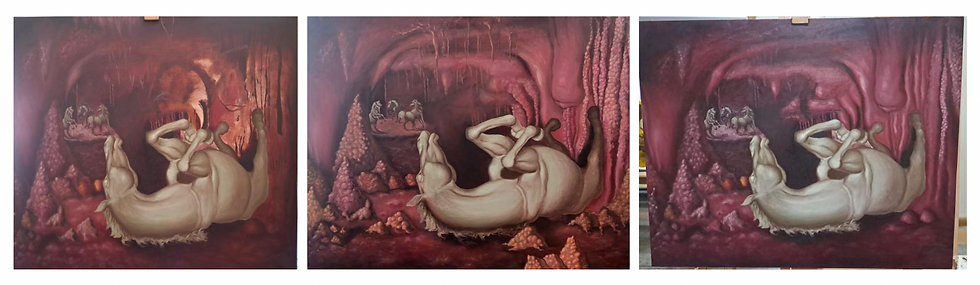
Once I finished the painting, I covered it with plastic foil and partially burned it — inspired by artist Alberto Burri's technique — creating holes and transparencies. The plastic evokes blisters or scars, but also the way we subconsciously try to hide or blur trauma.
Traditional art, or art in general, tends to be overlooked. I have even heard from some fellow art students that art is unnecessary or useless. I completely disagree. I believe people say that when they don't know the potential this profession holds.
Through a piece, an artist can shed light on important topics, criticize an aspect of society, share their testimony, or even protest. In that sense, it encourages people to question their surroundings and give their own opinion. It is not only making beautiful or hyperrealistic things — although I love that type of art as well. I would love people to realize the deeper side about being an artist.
In my case, I learned to take breaks as an essential part of my growth. This year, due to health issues, I wanted to take a break from university. While bureaucracy made it impossible for me to take a full year off, I still spent some months without painting anything on my own. Instead, I focused on teaching art to children, attending doctor appointments and reading about topics like psychology and world history.
When I returned to university, I was surprised; new ideas came faster and I wasn’t procrastinating anymore. My process felt lighter.
I say this as someone who had been dealing with burn out and frustration. I often spent weeks on a single piece. Hopefully, after that pause, I recovered my interest in creation.
Now, whenever I feel an artblock coming, I give myself permission to stop, even when deadlines are near. After that, not only do I feel recharged, but I also end up presenting my pieces on time and with better results.
As both an artist and an art teacher, I would recommend all beginners to master the fundamental topics first, like composition, perspective, proportions and color harmonies.
I suggest a private teacher so that they can identify common mistakes and correct them in person. However, I know that’s not always that accessible or affordable. Luckily, there are many resources. On Youtube, for example, Proko for anatomy, and Marco Bucci for color theory. I also encourage finding artists who work with unconventional media because it’s a way to learn to enjoy the process with less pressure.
Most importantly, learning to accept feedback is essential. I always ask my friends about their opinions and what they would have done, even when I’m feeling insecure. Their insights always help me.
If anyone wants advice or feedback, they’re welcome to send me a message on Instagram. I would be happy to help.
Until next time!
Jenny

Comments